Do Men Need Pelvic Floor Physical Therapy? Yes! Here’s Why
Do Men Need Pelvic Floor Physical Therapy? Yes, Here’s Why
Pelvic floor physical therapy isn't just for women. If you're a man dealing with urine leakage, frequent trips to the bathroom, difficulty emptying your bladder or bowels, pelvic or testicular pain, discomfort with sex or ejaculation, changes in sexual function, or problems after prostate treatment, your pelvic floor may be part of the picture.
And no, you don't necessarily just need to “do more Kegels.”
Men have pelvic floor muscles too. These muscles help with bladder and bowel control, sexual function, pelvic support, and managing pressure during movement and exercise. Like other muscles, they need to be able to contract, relax, and coordinate at the right time.
When that system isn't working well, pelvic floor physical therapy may be able to help.
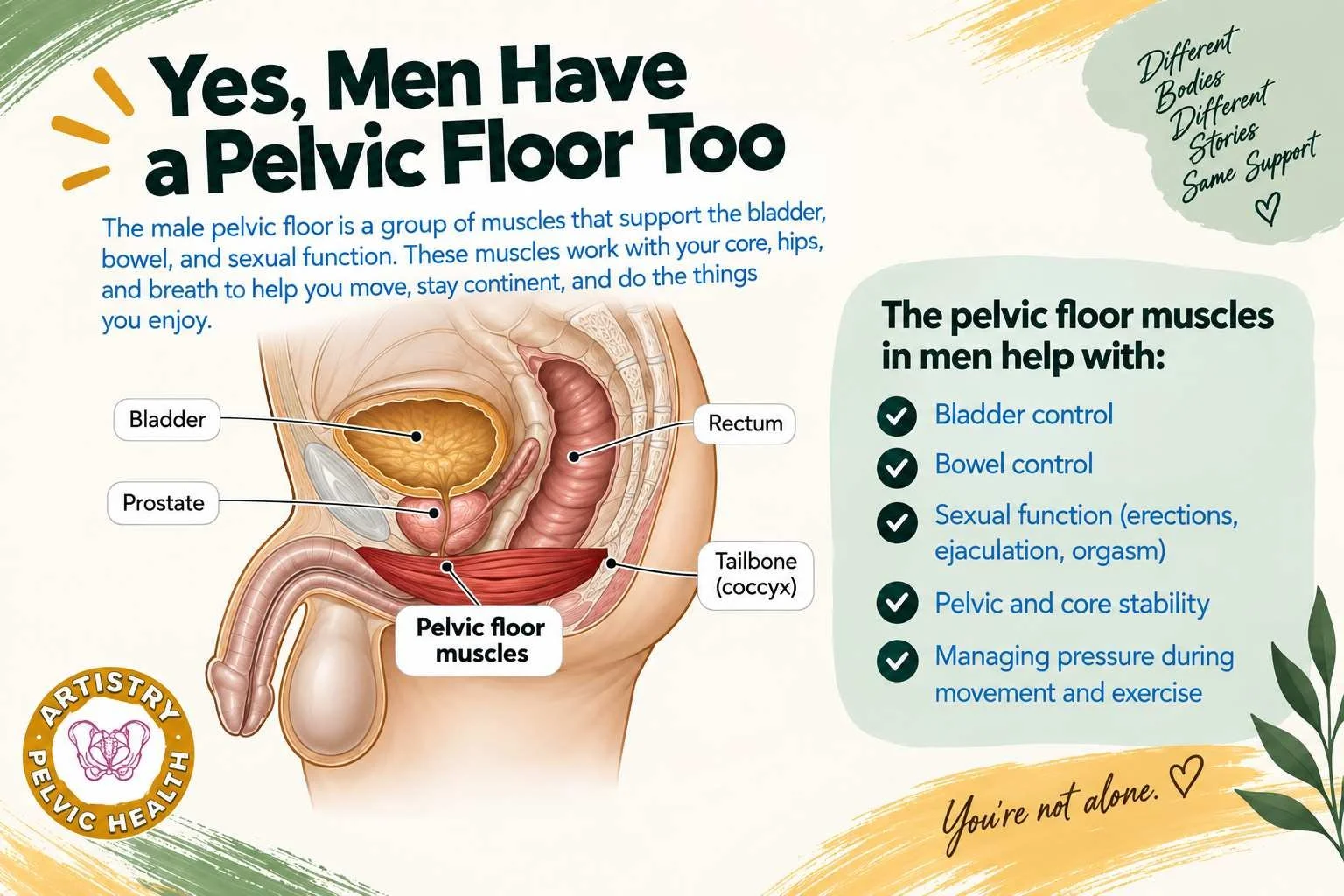
Yes, Men Have a Pelvic Floor
The male pelvic floor is a group of muscles and connective tissues at the bottom of the pelvis. It works with the bladder, urethra, rectum, abdominal muscles, diaphragm, hips, and other surrounding structures.
Your pelvic floor helps you:
Control urine and bowel movements
Support the pelvic organs
Coordinate pressure during lifting, exercise, coughing, and other movement
Contribute to erection and ejaculation
Relax appropriately for urination and bowel movements
That last point matters: your pelvic floor isn't supposed to squeeze all day. Good function includes both contraction and relaxation.
For the full anatomy tour, read meet your pelvic floor: the small muscles that do big jobs.
How Do I Know If My Pelvic Floor Might Need Help?
Pelvic floor problems don't look the same in every man. You may have one symptom or several, and having one of these symptoms does not automatically mean the pelvic floor is the cause. A medical or pelvic health evaluation can help sort that out.
Bladder Symptoms
Urine leakage with coughing, sneezing, lifting, or exercise
Leakage after prostate treatment
Urinary urgency or frequency
Difficulty starting your urine stream
A slow or interrupted stream
Feeling like you haven't completely emptied
Post-void dribbling
Your pelvic floor has to help maintain continence and also relax when it's time to urinate. That means urinary symptoms can sometimes involve weakness, poor timing, excessive tension, or other medical and urologic factors.
Bowel Symptoms
Constipation or frequent straining
Difficulty relaxing to have a bowel movement
Feeling incompletely emptied
Difficulty controlling gas or stool
Rectal or pelvic discomfort with bowel movements
Bowel emptying requires coordination between the abdomen, rectum, anal sphincters, and pelvic floor. More squeezing is not always the answer.
Pelvic, Genital, or Scrotal Pain
Pain in the perineum—the area between the scrotum and anus
Penile or testicular/scrotal pain
Rectal or tailbone pain
Lower-abdominal, groin, hip, or pelvic pain
Pain that worsens with sitting
Pain during or after ejaculation
Male chronic pelvic pain can be complex. The American Urological Association's 2025 guideline emphasizes that symptoms and contributing factors may extend beyond the urinary system and that care may need to be multimodal and multidisciplinary. Pelvic floor physical therapy can be particularly relevant when pelvic-floor or abdominopelvic muscle tenderness or myalgia is present.
Sexual Health Concerns
Pain with arousal, sexual activity, or ejaculation
Changes in erection quality
Changes in ejaculation or orgasm
Pelvic tension or discomfort associated with sexual activity
The pelvic floor contributes to erection and ejaculation, but sexual function is influenced by many systems, including vascular, neurologic, hormonal, psychological, and relational factors. Pelvic floor treatment may be one piece of care rather than the entire answer.
Research suggests pelvic floor muscle training can improve erectile dysfunction and premature ejaculation in some men, although studies have used different treatment programs and an ideal protocol has not been established.
Pelvic Floor PT Before and After Prostate Surgery
Pelvic floor rehabilitation is especially relevant for men undergoing treatment for prostate cancer.
Urinary leakage is common after radical prostatectomy. The American Urological Association and Society of Urodynamics, Female Pelvic Medicine & Urogenital Reconstruction guideline states that men may be offered pelvic floor muscle exercises or training before radical prostatectomy and should be offered pelvic floor muscle exercises or training after surgery.
Guided training can help you learn how to correctly identify and use the pelvic floor rather than simply squeezing as hard as possible. Rehabilitation may also address breathing, abdominal coordination, movement, pressure management, and your gradual return to activity.

Pelvic floor physical therapy does not replace your urologist or other medical care after prostate treatment. It can be one part of your recovery team.
Your Pelvic Floor Doesn't Always Need to Be Stronger
One of the biggest misconceptions in men's pelvic health is that every pelvic floor problem should be treated with Kegels.
That's not how pelvic floor rehabilitation works.
Depending on your symptoms and examination, your pelvic floor may need to:
Build strength or endurance
Learn to relax and lengthen more effectively
Improve timing and coordination
Coordinate better with breathing and abdominal pressure
Reduce unnecessary muscle guarding or tension
Improve how it responds during exercise, urination, bowel movements, or sexual activity
For example, a man with urinary leakage after prostate surgery may benefit from strengthening and coordination. A man with chronic pelvic pain and a tender, overactive pelvic floor may need a very different approach. The same exercise is not appropriate for every person.
The same exercise is not appropriate for every person, read more on that in what is pelvic floor dysfunction? Signs, Symptoms & When to Get Help
What Actually Happens During Men's Pelvic Floor Physical Therapy?
If you've never heard of pelvic floor PT for men, you may be wondering what an appointment actually involves.
We start by talking.
Your physical therapist may ask about your symptoms, bladder and bowel habits, pain, sexual health, surgeries or medical treatment, exercise, work, and the activities that are difficult for you. From there, the physical assessment may look at areas such as:
· Breathing and pressure management
· Abdominal and core function
· Back and hip mobility
· Lower-body strength
· Posture and movement
· Muscle tension or tenderness
· How the pelvic floor contracts, relaxes, and coordinates
Depending on your symptoms and goals, pelvic floor assessment may include an external examination and, when clinically appropriate, an internal rectal examination of the pelvic floor muscles.
An internal examination is not automatically required.
At Artistry Pelvic Health, examination and treatment should happen with your informed consent and at a pace you are comfortable with. You can ask questions, decline an examination technique, or discuss alternatives.
New to all of this? Start with our beginner's guide to pelvic floor PT.
What Can Treatment Look Like?
Your treatment should match what your evaluation finds. Depending on your needs, pelvic floor PT may include:
Pelvic floor strengthening or coordination training
Relaxation or down-training
Breathing and pressure-management strategies
Bladder or bowel retraining
Mobility and flexibility work
Core, hip, and whole-body strengthening
Manual therapy when appropriate
Movement and exercise retraining
Education about sexual or pelvic function within the physical therapist's scope
An individualized home program
For men with chronic pelvic pain and pelvic-floor muscle myalgia, current AUA guidance supports specialized pelvic floor physical therapy as part of a broader, multimodal approach; techniques may include manual myofascial treatment and biofeedback when appropriate.
When Should You Talk to Someone?
Consider talking with a healthcare professional or pelvic floor physical therapist if urinary, bowel, pelvic pain, or sexual symptoms are persistent, recurring, worsening, or interfering with your quality of life.
Pelvic floor PT can also be worth discussing if you're preparing for or recovering from prostate surgery.
Some symptoms require medical evaluation rather than assuming the pelvic floor is responsible. Seek prompt medical care for concerns such as inability to urinate, blood in the urine, fever or signs of infection, sudden severe pelvic or testicular pain, a new testicular lump or swelling, or new significant neurologic symptoms
Men's Pelvic Health Is Health
You don't have to wait until a pelvic problem becomes severe, or embarrassing enough that it starts changing how you live.
Bladder problems. Constipation. Pelvic pain. Sexual concerns. Recovery after prostate surgery.
These are health concerns, and they deserve thoughtful evaluation.
At Artistry Pelvic Health, we work with men experiencing pelvic health concerns using an individualized, whole-body approach. The goal isn't to hand every man the same set of Kegels. It's to understand what your body needs and build a plan around you. See our men's pelvic health services.

Your pelvic floor is part of your health. It's okay to get help for it.
-
1. American Urological Association. Diagnosis and Management of Male Chronic Pelvic Pain: AUA Guideline. 2025.
2. American Urological Association / Society of Urodynamics, Female Pelvic Medicine & Urogenital Reconstruction. Incontinence after Prostate Treatment: AUA/SUFU Guideline.
3. Myers C, Smith M. Pelvic floor muscle training improves erectile dysfunction and premature ejaculation: a systematic review. Physiotherapy. 2019;105(2):235–243. doi:10.1016/j.physio.2019.01.002.
-
Image 1:
Yes, Men Have a Pelvic Floor Too.Provided by Artistry Pelvic Health / created for this blog workflow.
Image 2:
Men's Pelvic Health: More Than You Might Think.” Branded infographic around a male figure.Provided by Artistry Pelvic Health / created for this blog workflow.
Image 3:
Not Every Man Needs More Kegels.
Provided by Artistry Pelvic Health / created for this blog workflow.
Wondering whether pelvic floor PT is right for you?
Book a free discovery call with Dr. Ciara, no pressure, no commitment, just answers.