
When the Body Remembers: How Trauma Can Affect the Pelvic Floor
If you're dealing with pelvic pain, bladder or bowel changes, muscle tension, or discomfort with intimacy, and your symptoms seem to change from day to day or don't fully make sense, there may be more than one system involved.
Sometimes medical testing doesn't identify a clear explanation, yet the symptoms are still very real.
One piece of the puzzle that deserves attention is the nervous system and the way our bodies adapt to stress, pain, fear, injury, and traumatic experiences.
For some people, these responses can influence the pelvic floor.
What Is the Pelvic Floor?
The pelvic floor is a group of muscles and connective tissues at the bottom of the pelvis. These muscles help support the bladder, bowel, uterus or prostate and contribute to several important functions, including:
Bladder and bowel control
Sexual function
Pelvic-organ support
Core stability
Pressure management during movement
Healthy pelvic-floor function isn't just about having strong muscles.
Your pelvic floor also needs to be able to contract, relax, lengthen, and coordinate with your breathing, abdominal muscles, hips, back, and the rest of your body.
When this system isn't functioning well, symptoms can develop.
If you want a closer look at the anatomy, read: Meet Your Pelvic Floor: The Small Muscles That Do Big Jobs.
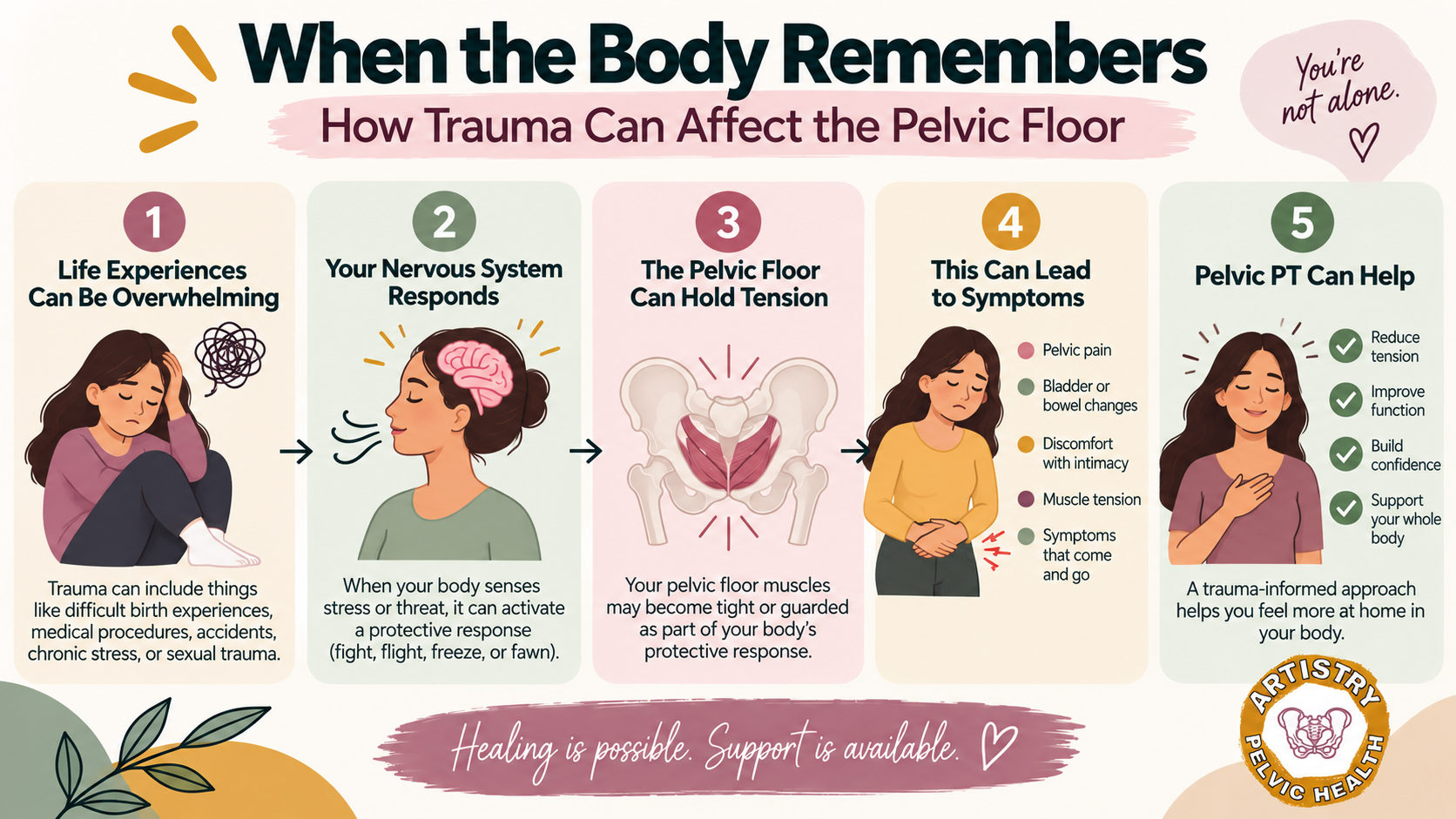
What Does Trauma Have to Do With the Pelvic Floor?
When people hear the word trauma, they may think only of a major or life-threatening event.
But experiences that can affect someone's stress response may include:
A difficult or frightening childbirth
Painful or distressing medical procedures
Sexual trauma or violation
Accidents or physical injuries
Repeated experiences of pain
Chronic or overwhelming stress
Other experiences involving fear, loss of control, or a sense of threat
Not everyone who experiences trauma will develop pelvic-floor symptoms.
And having pelvic-floor dysfunction does not mean that you necessarily have a history of trauma.
Instead, trauma and chronic stress are best understood as possible contributors within a much larger picture.
How Stress and Trauma May Affect the Pelvic Floor
Your nervous system is constantly gathering information and helping your body respond to what's happening around you.
When you perceive a threat, your body can activate a protective stress response. Your heart rate and breathing may change, and muscles throughout the body may increase their activity or begin to brace.
For some people, that can include the abdominal, gluteal, and pelvic-floor muscles.
If muscle guarding or altered movement patterns persist, they may contribute to symptoms such as:
Pelvic-floor tension or tenderness
Difficulty relaxing the pelvic floor
Changes in breathing or abdominal bracing
Pelvic pain
Pain with penetration or sexual activity
Difficulty relaxing during urination or bowel movements
Importantly, these symptoms can also have many other causes.
That's why pelvic symptoms deserve an individualized evaluation rather than assuming that stress or trauma is responsible.
Why Pelvic Floor Symptoms Can Change From Day to Day
One of the most frustrating things about chronic pelvic symptoms is that they don't always behave predictably.
You may have a great week followed by a flare-up. Symptoms may change with:
Physical activity
Menstrual-cycle changes
Sleep
Stress
Sexual activity
Bowel or bladder habits
Prolonged sitting
Illness
Previous pain experiences
Sometimes there isn't an obvious trigger at all.
That's because pain is not determined by one structure alone.
Chronic pelvic pain is generally understood through a biopsychosocial framework. Muscles, nerves, organs, previous injuries, medical conditions, movement, sleep, emotions, stress, social circumstances, and pain processing may all contribute.
So when imaging or other testing doesn't identify a structural explanation, that does not mean the symptoms are imagined. It means additional contributors may need to be considered.
The Stress–Tension–Pain Cycle
Pain, Stress, or Perceived Threat → Muscle Guarding → More Pain or Dysfunction → Fear or Avoidance → More Guarding
Consider someone who repeatedly experiences pain during penetration. After several painful experiences, they may begin anticipating that it will hurt again.
Their breathing changes. Their abdomen braces. Their pelvic floor may tighten. Penetration becomes uncomfortable again.
Now there is another painful experience reinforcing the expectation that penetration may hurt.
This does not mean the pain is psychological. The pain and muscle responses are real.
It illustrates how physical symptoms, nervous-system responses, thoughts, emotions, and previous experiences can influence one another. Breaking that cycle may therefore involve more than treating one muscle or structure.
What Does the Research Say About Trauma and Pelvic Pain?
Research does show an association between trauma history and chronic pelvic pain.
A 2025 systematic review and meta-analysis examined sexual-abuse history among women with and without chronic pelvic pain. Across the included studies, sexual abuse was more commonly reported among women with chronic pelvic pain.
But this finding needs to be interpreted carefully.
An association does not mean that trauma caused someone's pelvic pain.
Chronic pelvic pain is heterogeneous and can be associated with gynecologic, urologic, gastrointestinal, musculoskeletal, neurologic, psychological, and other factors.
For some people, trauma history may be clinically relevant. For others, it may not be.
The goal is not to search for trauma as an explanation for every symptom. It's to recognize that someone's experiences, nervous system, and emotional health can be relevant parts of whole-person care.
Childbirth, the Nervous System, and the Pelvic Floor
Pregnancy and childbirth can create significant changes in the pelvic floor. Some people may experience:
· Urinary or bowel symptoms
· Pelvic or vaginal pain
· Pelvic pressure or heaviness
· Pain with intimacy
· Difficulty returning to exercise
· Scar sensitivity
· Pelvic-floor weakness or tension
The landmark Nygaard study found that 23.7% of nonpregnant U.S. women reported symptoms of at least one pelvic-floor disorder, with prevalence increasing with age and number of births. That statistic included urinary incontinence, fecal incontinence, and symptomatic pelvic-organ prolapse, it should not be interpreted as the percentage of women injured during childbirth.
Birth can also be emotionally distressing or traumatic for some people.
A person may experience anxiety around medical environments, fear of certain movements or examinations, or difficulty feeling comfortable with pelvic touch after a difficult birth experience.
Those concerns deserve compassionate care alongside the physical aspects of postpartum recovery.
How Trauma-Informed Pelvic Floor Physical Therapy Can Help
Pelvic floor physical therapy is about much more than strengthening. Treatment should be based on what your evaluation actually finds.
Breathing and Pressure Management
The diaphragm, abdominal wall, and pelvic floor work together during breathing and changes in abdominal pressure. Treatment may help improve this coordination and reduce unnecessary breath holding or bracing.
Pelvic Floor Relaxation or Strengthening
Not everyone needs Kegels. Some people need more strength or endurance. Others need help relaxing or lengthening the pelvic floor. Still others need better coordination between contraction and relaxation.
The right treatment depends on what your body needs.
Movement and Exercise
Treatment may include mobility, strengthening, movement retraining, and gradually returning to activities that have become difficult or uncomfortable.
Manual Therapy
When clinically appropriate and desired by the patient, hands-on treatment may be one component of pelvic-floor rehabilitation.
However, the evidence for specific manual-therapy approaches in chronic pelvic pain remains limited and heterogeneous. Manual therapy should therefore be considered one possible tool, not a universal treatment or a way to “release stored trauma.”
Biofeedback
In selected pelvic-floor conditions, biofeedback may help people improve awareness and control of pelvic-floor activity. Evidence is stronger for certain conditions than others, and research in chronic pelvic-pain populations remains variable.
Pain Education and Self-Management
Understanding how pain works and recognizing factors that may increase or decrease symptoms can help make chronic symptoms feel less unpredictable.
Treatment may also include strategies for activity modification, symptom management, and gradually returning to meaningful activities.
What Does Trauma-Informed Pelvic Floor Care Look Like?
Trauma-informed pelvic floor physical therapy is not trauma therapy.
A physical therapist's role is not to process traumatic memories unless they have separate qualifications that allow them to provide that type of mental-health treatment.
Instead, trauma-informed care changes how healthcare is delivered.
APTA recommends trauma-informed education across the physical therapy profession, including recognizing the effects of trauma and using practices designed to reduce the risk of retraumatization.
In pelvic health, this is particularly important because evaluation and treatment can involve intimate conversations, physical touch, and sometimes internal pelvic examinations.
Trauma-informed pelvic health care may prioritize:
Choice. Consent. Communication. Collaboration. Respect.
Explaining an examination before beginning
Asking permission before touch
Checking in throughout an examination
Allowing you to change your mind
Choosing an external assessment instead of an internal examination
Discussing alternatives
Stopping whenever you want to stop
You also do not have to disclose the details of a traumatic experience to receive trauma-informed care.
Your healthcare should be something done with you, not to you.
What Can You Start Doing Now?
If some of this sounds familiar, start with curiosity rather than blame.
Instead of immediately asking: “What's wrong with me?”
You might ask: “What seems to make my symptoms better or worse?”
Notice whether your symptoms change with sleep, stress, movement, bowel habits, your menstrual cycle, sexual activity, exercise, prolonged sitting, or other factors.
You might also experiment with comfortable strategies such as:
Slow, relaxed breathing
Gentle movement
Walking
Changing positions
Taking movement breaks
Activities that help reduce overall tension
These aren't cures for trauma or pelvic-floor dysfunction. They're simply ways to begin learning more about how your body responds.
If symptoms are persistent, recurring, worsening, or affecting your bladder, bowels, intimacy, exercise, work, or quality of life, consider getting evaluated by an appropriate healthcare professional.
Your Symptoms Deserve to Be Understood
Pelvic-floor symptoms don't always have one straightforward explanation.
Sometimes strength is part of the problem. Sometimes tension or difficulty relaxing is involved. Sometimes coordination is the issue.
And sometimes symptoms are influenced by a combination of medical conditions, pain, previous injuries, movement patterns, nervous-system responses, stress, and lived experiences.
Recognizing those connections doesn't make your symptoms less physical. It simply gives us a broader and often more useful way to understand them.
At Artistry Pelvic Health, pelvic floor physical therapy is individualized, trauma-informed, and whole-body focused.
You don't need to figure out whether your pelvic floor is weak, tight, overactive, or poorly coordinated before you come in.
That's what the evaluation is for.
Frequently Asked Questions
-
Trauma should not automatically be considered the cause of pelvic-floor dysfunction. However, trauma and chronic stress can influence pain processing, muscle guarding, behavior, and nervous-system responses. For some people, these factors may contribute to pelvic symptoms alongside other physical or medical factors.
-
Stress can be associated with increased muscle activity and guarding throughout the body. Some people notice more pelvic tension or worsening pelvic symptoms during stressful periods, but stress is not the only possible explanation for a tight or painful pelvic floor.
-
Pelvic floor PT can address physical problems such as pelvic-floor dysfunction, pain, movement limitations, bladder or bowel symptoms, and muscle coordination when these are present. A trauma-informed approach also emphasizes patient choice, communication, consent, and reducing the risk of retraumatization.
-
No. Trauma-informed care does not require you to disclose details of traumatic experiences. You can decide what personal information you are comfortable sharing and what examinations or treatments you consent to.
-
No. Normal imaging does not establish that stress or trauma is causing pelvic pain. Many contributors to pelvic pain, including some musculoskeletal and pelvic-floor problems, may not be identified on routine imaging. Persistent symptoms still deserve appropriate evaluation.
-
Nogueira Neto J, Santos Silva TG, Nogueira MB, et al. Prevalence of sexual abuse in women with and without chronic pelvic pain: a systematic review and meta-analysis. Women Health. 2025;65(8):684-693. PubMed PMID: 40984724.
Nygaard I, Barber MD, Burgio KL, et al. Prevalence of symptomatic pelvic floor disorders in US women. JAMA. 2008;300(11):1311-1316. doi:10.1001/jama.300.11.1311.
Fuentes-Márquez P, Cabrera-Martos I, Valenza MC. Physiotherapy interventions for patients with chronic pelvic pain: a systematic review of the literature. Physiother Theory Pract. 2019;35(12):1131-1138. PubMed PMID: 29757068.
Wagner B, Steiner M, Huber DFX, Crevenna R. The effect of biofeedback interventions on pain, overall symptoms, quality of life and physiological parameters in patients with pelvic pain: a systematic review. Wien Klin Wochenschr. 2022;134:11-48. PubMed PMID: 33751183.
American Physical Therapy Association (APTA). Trauma-Informed Care. https://www.apta.org/patient-care/public-health-population-care/trauma-informed-care
APTA Pelvic Health. Imbuing Concepts of Trauma-Informed Care into Everyday Practice as Pelvic Health Physical Therapists. https://www.aptapelvichealth.org/info/imbuing-concepts-of-trauma-informed-care-into-everyday-practice-as-pelvic-health-physical-therapists
-
When the body remembers: how trauma can affect the pelvic floor
Branded infographic Provided by Artistry Pelvic Health / created for this blog workflow.
Wondering whether pelvic floor PT is right for you?
Book a free discovery call with Dr. Ciara, no pressure, no commitment, just answers.