4 Pelvic Health Myths You May Still Believe
False information about pelvic health is everywhere.
And I'm not just talking about social media or random Google searches. Pelvic health myths can come from well-meaning family members, friends, coworkers, and sometimes even healthcare professionals.
You may have heard:
“Pain during sex is just normal for some people.”
“Of course you leak. You've had a baby.”
“Some people just have terrible periods.”
“Once you have prolapse, it's only going to get worse.”
When we hear messages like these often enough, it's easy to start believing them. And those beliefs can shape what we do next.
Maybe you stop exercising because you're afraid of making a prolapse worse. Maybe you wear a pad every day and assume bladder leakage is your new normal. Maybe you plan work, school, travel, or social activities around severe period pain.
On the other side, pelvic health misinformation can also lead people toward expensive “quick fixes” or promises of guaranteed cures that aren't supported by evidence.
Good pelvic healthcare should do neither. It should help you understand your symptoms, recognize when medical evaluation is appropriate, and learn what evidence-based options may be available.
Here are four common pelvic health myths you don't have to keep believing.
Myth #1: Pain During Sex Is Just Normal for Some People
The truth: Frequent, severe, or persistent pain during sex deserves attention.
Pain during sex is common. ACOG notes that many women experience it at some point, and for some people it is temporary. But frequent or severe pain should not simply be dismissed as something you have to live with.
Pain with sexual activity can have many possible contributors, including:
Pelvic-floor muscle tension, guarding, or difficulty relaxing
Endometriosis or other gynecologic conditions
Vaginal or vulvar irritation, infection, or inflammation
Hormonal changes, dryness, or difficulty with lubrication
Changes after childbirth, injury, or surgery
Difficulty with arousal or other sexual-response factors
Stress, fear, or anticipation of pain
Previous painful or traumatic experiences
That is why painful sex should not automatically be blamed on one muscle, one diagnosis, or one emotional factor.
How can pelvic floor PT help?
When pelvic-floor or musculoskeletal factors are contributing, pelvic floor physical therapy may address muscle tension or tenderness, breathing and pelvic-floor coordination, mobility, scar sensitivity, movement, and a gradual return to comfortable activity. Internal examination or treatment is not automatically required and should only occur when clinically appropriate and with informed consent.
Takeaway: An occasional episode of discomfort can happen, but frequent, severe, or persistent pain deserves evaluation. You do not have to simply accept ongoing painful sex as your normal.
Myth #2: Bladder Leaks Are an Unavoidable Part of Having a Baby
The truth: Leakage is common during and after pregnancy, but it is treatable and is not an inevitable lifelong outcome.
Pregnancy and childbirth place significant demands on the pelvic floor and surrounding tissues. Some people notice leaking when they cough, sneeze, laugh, run, jump, lift, or exercise.
But having given birth does not mean you are destined to leak forever.
Pelvic floor muscle training is one of the best-supported conservative treatments for stress urinary incontinence. A Cochrane review found that pelvic floor muscle training increased the likelihood of cure or improvement compared with no treatment or inactive treatment, and clinical guidelines recommend supervised pelvic floor muscle training as first-line care for stress or mixed urinary incontinence.
Still, it is important not to turn that evidence into another oversimplified message: “Just do Kegels.”
Depending on the person, rehabilitation may address:
Pelvic-floor strength and endurance
Timing and coordination
The ability to relax when needed
Breathing and pressure management
Bladder habits
Movement and exercise technique
And not everyone will experience a complete cure. Some people improve substantially, while others may need additional medical or urogynecologic evaluation and treatment.
Takeaway: Bladder leakage after pregnancy or childbirth is common, but effective treatment options exist. It should not automatically be treated as your permanent “new normal.”
New to all of this? Start with our beginner's guide to pelvic floor PT.
Have questions about your symptoms?
BOOK a FREE DISCOVERY CALL with Dr. Ciara, no pressure, no commitment, just answers.
Myth #3: Severe Period Pain Is Just Normal for Some People
The truth: Period pain can occur without another disease, but severe, worsening, or life-disrupting pain deserves evaluation.
This myth needs a little nuance.
Painful periods called dysmenorrhea are common. Some people have primary dysmenorrhea, meaning menstrual cramping occurs without another pelvic disease being identified. So severe period pain does not automatically prove that something else is wrong.
At the same time, pain that repeatedly keeps you from school, work, sleep, exercise, or normal daily activities should not simply be brushed off.
ACOG recommends seeking help when period pain is severe, worse than usual, or makes life difficult each month. Secondary dysmenorrhea can be related to conditions such as:
Endometriosis
Adenomyosis
Uterine fibroids
Other gynecologic or pelvic conditions
Evaluation becomes especially important when pain is worsening over time or occurs alongside other concerning symptoms.
Where does pelvic floor PT fit in?
Pelvic floor physical therapy does not diagnose or cure endometriosis, adenomyosis, fibroids, or other medical causes of period pain. But people with persistent pelvic pain can also develop pelvic-floor tenderness, muscle guarding, movement limitations, or other musculoskeletal contributors. When those are present, pelvic floor PT may be one part of a broader treatment plan.
Takeaway: Painful periods can occur even without another pelvic disease, but severe, persistent, worsening, or life-disrupting period pain deserves appropriate medical evaluation.
Read our article on Pelvic Physical Therapy for Endometriosis
Myth #4: Pelvic Organ Prolapse Will Inevitably Get Worse and Require Surgery
The truth: Prolapse does not automatically progress to surgery, and conservative treatment can improve symptoms for many people.
Pelvic organ prolapse occurs when one or more pelvic organs descend toward or into the vaginal canal because the supporting muscles and connective tissues are no longer providing the same level of support.
Symptoms may include:
Vaginal heaviness or pressure
A bulging sensation or visible bulge
Bladder or bowel changes
Symptoms that become more noticeable after prolonged standing or certain activities
Hearing the word “prolapse” can be frightening. But a prolapse diagnosis does not automatically mean your symptoms will continuously worsen or that surgery is inevitable.
Guidelines recommend supervised pelvic floor muscle training as a conservative option for certain people with symptomatic pelvic organ prolapse, and pessaries are another non-surgical option. Systematic reviews have found that pelvic floor muscle training can improve prolapse symptoms and pelvic-floor function, although changes in prolapse stage and long-term effects are less certain.
What about exercise and lifting?
A prolapse diagnosis does not automatically mean you must stop exercising or lifting. At the same time, the research does not support promising that every activity, including heavy lifting, running, jumping, or trampoline use is appropriate for every person with prolapse.
Evidence about strenuous exercise and prolapse is still developing, and symptoms, prolapse severity, goals, technique, and individual response matter. Pelvic floor PT can help with graded return to activity, pelvic-floor coordination, breathing and pressure management, constipation and straining, and symptom-guided exercise modifications.
Takeaway: Prolapse can often be managed conservatively. Surgery is an option for some people, not an inevitable outcome for everyone.
So, How Can You Spot a Pelvic Health Myth?
Be cautious when pelvic-health advice relies on absolutes such as:
“This happens to everyone.”
“There's nothing you can do.”
“You'll never be able to do that again.”
“Everyone with this condition needs the same treatment.”
“Just do Kegels.”
Pelvic health is rarely that simple.
But be skeptical of the opposite extreme, too: anyone promising a guaranteed cure, an instant fix, or one exercise or product that works for everyone.
Good pelvic healthcare leaves room for individual differences, appropriate medical evaluation, evidence-based treatment, and honest conversations about what we know and what we don't.
What Can You Do With This Information?
Start by asking questions. Advocate for yourself when something doesn't feel right. Look for information from qualified healthcare professionals and reputable medical organizations.
And remember: a symptom being common does not necessarily mean you have to accept it without exploring your options.
If you're dealing with bladder leakage, painful sex, pelvic pain, prolapse symptoms, or another pelvic-health concern, an individualized evaluation can help determine what may be contributing to your symptoms and what options make sense for you.
At Artistry Pelvic Health, my goal isn't simply to tell you what exercises to do. It's to help you better understand your body, identify factors that may be contributing to your symptoms, and build practical strategies for moving forward with greater confidence.
Frequently Asked Questions
-
Pain during sex is common and can sometimes be temporary, but frequent or severe pain deserves evaluation. Possible contributors include pelvic-floor dysfunction, endometriosis or other gynecologic conditions, vaginal or vulvar conditions, hormonal changes, previous childbirth or injury, and sexual-response factors.
-
Urinary leakage is common during and after pregnancy, but you do not have to assume it will be permanent. Pelvic floor muscle training is a recommended first-line treatment for stress and mixed urinary incontinence, although individual outcomes vary.
-
Menstrual cramping is common, and primary dysmenorrhea can occur without another pelvic disease. But severe, worsening, or persistent pain, especially pain that disrupts work, school, sleep, or everyday activities, deserves medical evaluation.
-
No. Treatment depends on symptoms, prolapse severity, goals, and individual circumstances. Conservative options can include supervised pelvic floor muscle training and a vaginal pessary. Surgery may be appropriate for some people, but it is not inevitable for everyone.
-
Often, yes - but the right type and amount of exercise are individual. Evidence about strenuous activity and prolapse is still developing. Symptoms, prolapse severity, goals, technique, and response to activity should guide decisions rather than a blanket rule to avoid exercise.
-
American College of Obstetricians and Gynecologists (ACOG). When Sex Is Painful. Patient FAQ.
American College of Obstetricians and Gynecologists (ACOG). Dysmenorrhea: Painful Periods. Patient FAQ.
American College of Obstetricians and Gynecologists (ACOG). Endometriosis. Patient FAQ.
Dumoulin C, Cacciari LP, Hay-Smith EJC. Pelvic floor muscle training versus no treatment, or inactive control treatments, for urinary incontinence in women. Cochrane Database Syst Rev. 2018;10:CD005654. doi:10.1002/14651858.CD005654.pub4.
National Institute for Health and Care Excellence (NICE). Urinary incontinence and pelvic organ prolapse in women: management. NG123.
National Institute for Health and Care Excellence (NICE). Pelvic floor dysfunction: prevention and non-surgical management. NG210.
Wang T, Wen Z, Li M. The effect of pelvic floor muscle training for women with pelvic organ prolapse: a meta-analysis. Int Urogynecol J. 2022;33(7):1789-1801. doi:10.1007/s00192-022-05139-z.
Bø K, Anglès-Acedo S, Batra A, et al. Strenuous physical activity, exercise, and pelvic organ prolapse: a narrative scoping review. Int Urogynecol J. 2023;34(6):1153-1164. doi:10.1007/s00192-023-05450-3.
-
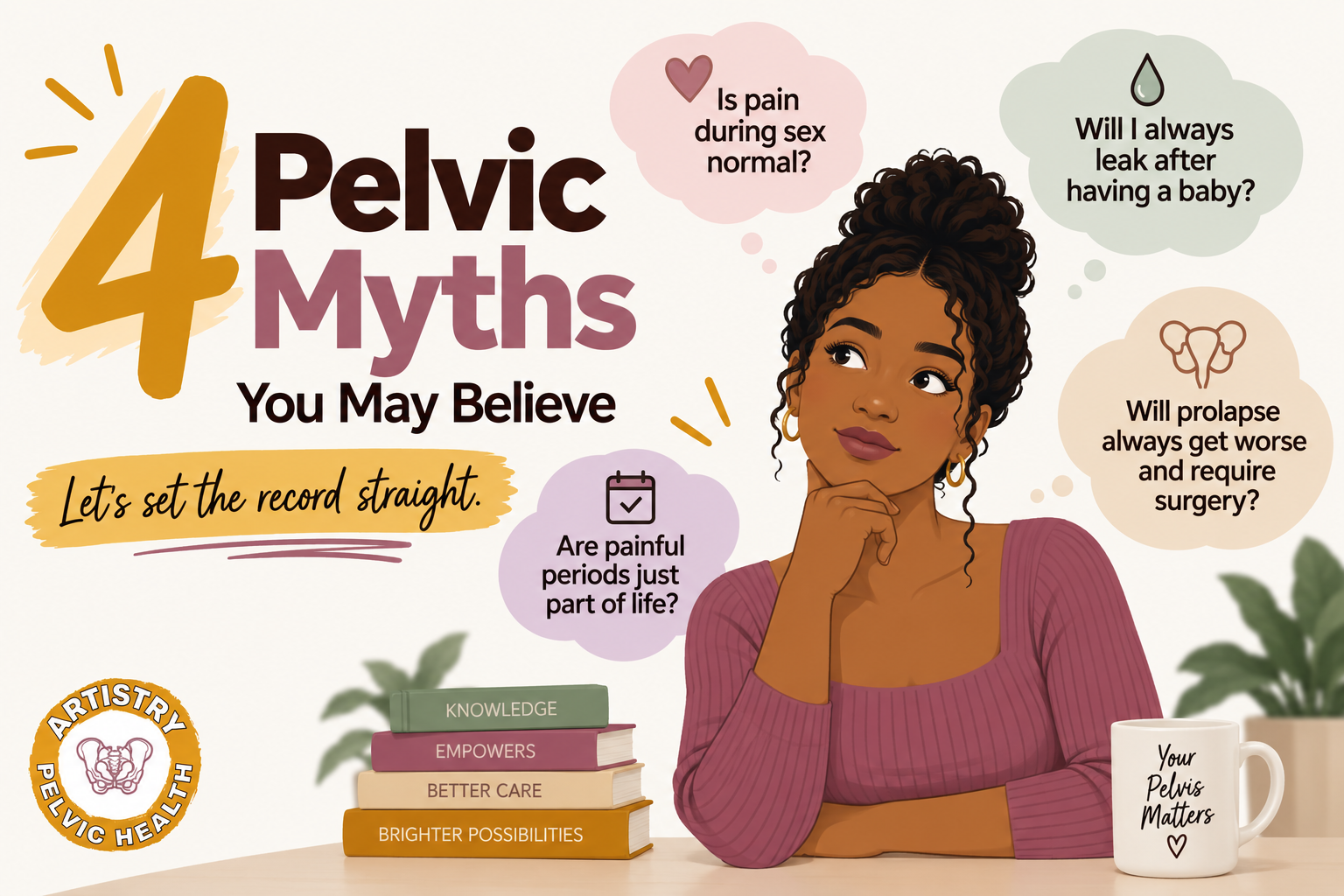
4 Pelvic health myth you may believe
Branded infographic Provided by Artistry Pelvic Health / created for this blog workflow.
Wondering whether pelvic floor PT is right for you?
Book a free discovery call with Dr. Ciara, no pressure, no commitment, just answers.